
Author: Mabel Espeche | Founder, Kantic · Agentic AI Talent Partner
The shift from AI assistants to autonomous agents isn't coming — it's already here. Here's what the numbers say about the biggest technological shift of our era.
Something fundamental changed in how AI works over the last 18 months — and most people outside of engineering circles haven't fully grasped what it means yet.
We've moved from AI that responds to AI that acts. From models that answer questions to systems that pursue goals, make decisions, use tools, and correct themselves when they fail. This is agentic AI — and it's not an incremental upgrade to the chatbot era. It's a category shift with market data to match.
The Market Is Moving Faster Than Anyone Predicted
The global agentic AI market sits at roughly $7.6 billion today. What comes next is where it gets striking.
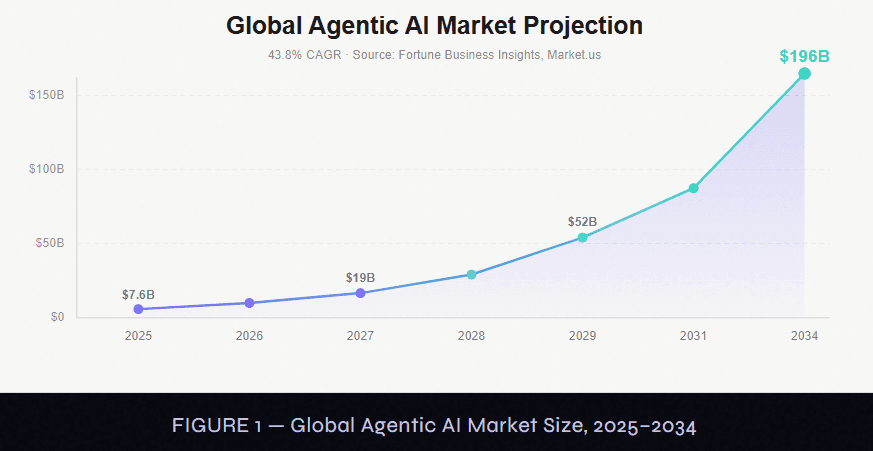
That $196 billion projection by 2034 represents a 43.8% compound annual growth rate — one of the steepest sustained growth curves in enterprise technology history. But the raw market size tells only part of the story. The more important signal is where this market is concentrating.
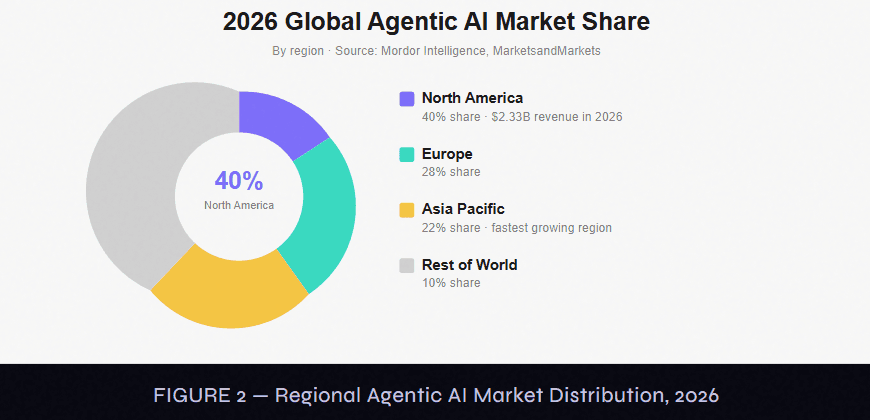
North America Leads — and the US Dominates
The US alone is estimated to reach $2.33 billion in agentic AI revenue in 2026, commanding roughly 40% of global market share. This dominance is driven by three structural advantages: the highest concentration of AI infrastructure investment, the deepest pool of venture capital, and — critically — proximity to the engineering talent that makes these systems actually work.
Adoption Is Exploding — But Production Is a Different Story
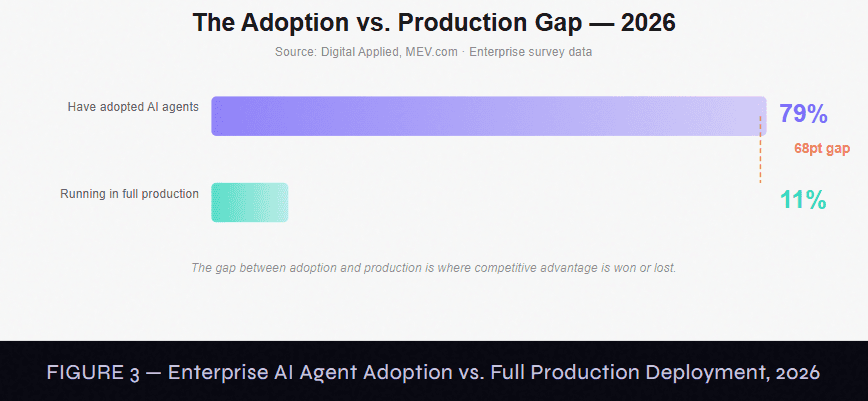
By early 2026, surveys indicated that 72% of enterprises had moved past AI trials into full-scale production deployments. The "pilot purgatory" phase that defined 2024 is over for the leaders. The followers are still stuck in it. And the gap between those two groups is the most important business story in technology right now.
"The gap between adoption and production isn't a technology problem. It's an engineering talent problem — and it will define which startups win the next decade."
The 68-percentage-point gap between those who have adopted and those running in production is the most important data point in this market. Nearly four in five companies have started — but only one in nine is capturing value. The bottleneck isn't the technology. What closes this gap is the quality of the engineering teams building and operating these systems.
What "Agentic AI" Actually Requires — Technically
The term gets used loosely, so it's worth being precise. An agentic AI system is one that can perceive its environment, reason across multiple steps, use external tools, manage persistent state, and self-correct when its outputs don't match its goals — all with minimal human intervention.
This is categorically different from a chatbot or a simple LLM wrapper. Building a real agentic system in production requires mastery across six distinct engineering disciplines:
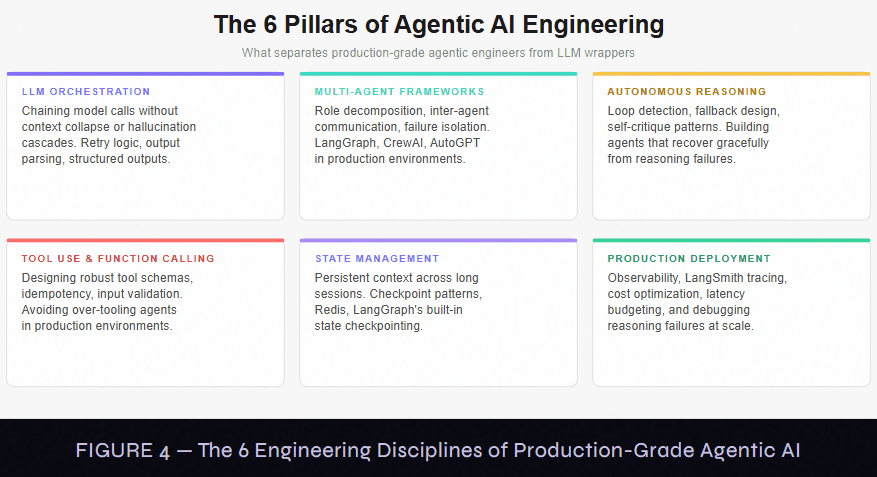
This is a fundamentally different skill set from traditional software engineering or even standard ML engineering. A candidate can ace a LeetCode interview and still be completely incapable of architecting a stable multi-agent system. And that's precisely why the talent gap — which we cover in depth in Part 2 — is so severe.
The core insight: The 68-point gap between enterprise adoption and production isn't a compute problem or a model capability problem. It's a people problem. Companies are trying to build systems their engineering teams don't have the depth to operate. That gap is where the next wave of competitive advantage will be won — and lost.
Sources:
Fortune Business Insights — Agentic AI Market Size, Share | Forecast Report 2026–2034. fortunebusinessinsights.com
Market.us — Agentic AI Market Size, Share, Trends | CAGR of 43.8% (January 2026). market.us
Digital Applied — Agentic AI Statistics 2026: 150+ Data Points Collection. digitalapplied.com
Mordor Intelligence — Agentic AI Market Share, Size & Growth Outlook to 2031. mordorintelligence.com
MarketsandMarkets — Agentic AI Market Report 2025–2032. marketsandmarkets.com
MEV.com — Agentic AI Market Outlook 2025–2026: Statistics on Adoption, ROI and Growth. mev.com
Related Reads for You
Discover more articles that align with your interests and keep exploring.