
The Talent Crisis Is Structural, Not Cyclical
Every founder I speak with identifies the same bottleneck: they can raise capital, they can define the product, but they cannot find the engineers to build it fast enough. This isn't a market cycle. It's a structural mismatch that will take years to close.
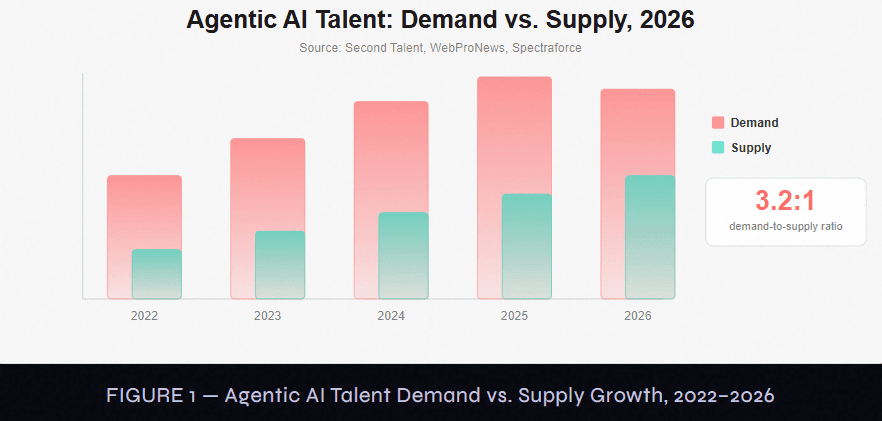
For every qualified agentic AI engineer in the market, there are more than three open positions competing for them. And the gap is widening, not narrowing. Demand for agentic AI roles grew 40% year-over-year in 2025, while the supply of qualified engineers grew just 7%.
The root causes are structural. Academic programs produce AI generalists while industry demands specialists. The professionals best positioned to train the next generation are moving into private sector roles — Stanford HAI's 2024 AI Index found that 70.7% of new AI PhDs went directly to industry, up 5.3 percentage points in a single year. The pipeline cannot self-correct at the pace demand is accelerating.
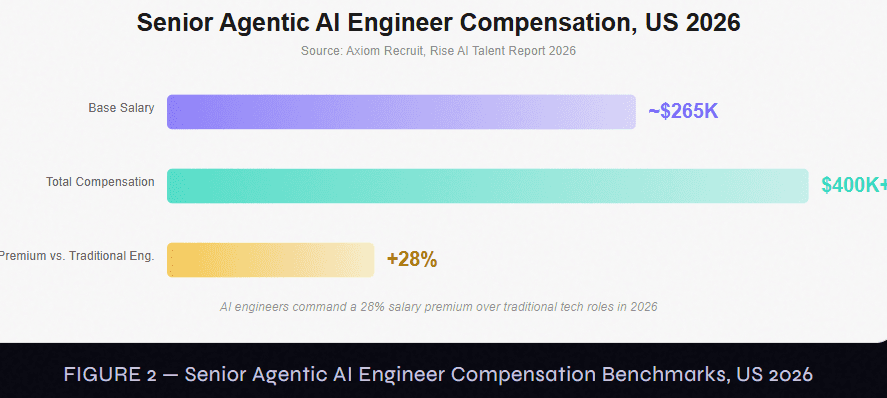
For seed-stage startups competing for this talent against Google and OpenAI, the challenge isn't just budget. It's sourcing, vetting, and moving fast enough to close before a better-funded competitor does. The engineers who can build production agentic systems are receiving multiple offers simultaneously and making decisions in days, not weeks.
Why Most Startups Are Losing the Talent War
The typical startup hiring process for senior AI engineers looks something like this: post a job description, wait for inbound applications, screen resumes, run multiple interview rounds, discover most candidates can talk the agentic AI talk but have never shipped a production multi-agent system, repeat for 8–12 weeks, lose the best candidate to a competing offer on week 10.
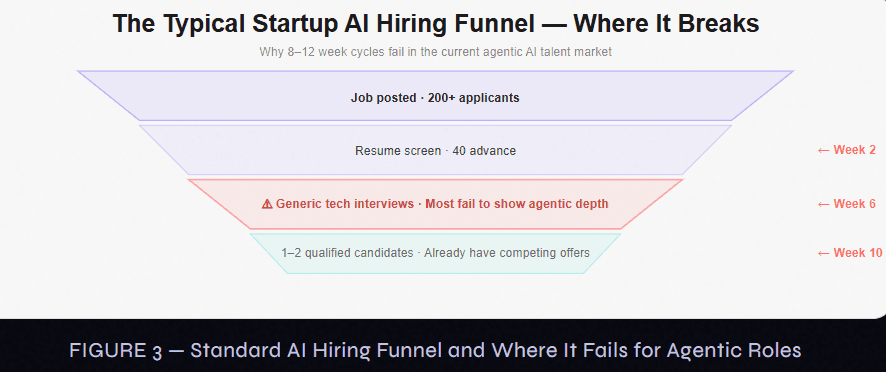
This approach has two fatal flaws in the current market.
First, the best agentic AI engineers are not applying to job postings. They're employed, well-compensated, and fielding inbound interest constantly. Passive sourcing requires deep network access and the credibility to reach engineers before they're actively looking.
Second, standard technical interviews — LeetCode problems, generic system design questions — are poorly calibrated for agentic AI depth. A candidate can pass every round and still be incapable of architecting a production multi-agent system. The vetting frameworks simply haven't kept up with the specialization.
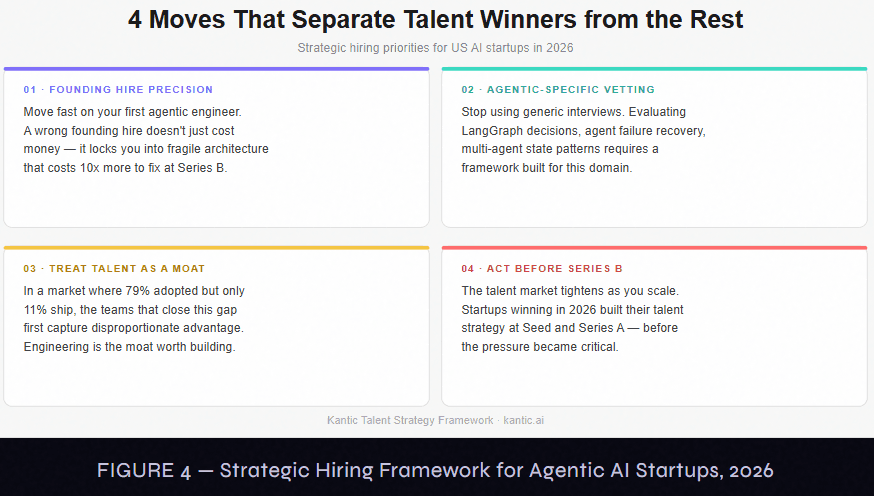
What Winning Looks Like — 4 Strategic Moves
The Opportunity Is Real — For Those Who Can Staff It
None of this is cause for pessimism. The agentic AI market is the most significant technological opportunity in a generation, and US startups are at the center of it. North America leads global adoption, and the ROI for companies that successfully deploy agentic systems is averaging 171% by enterprise estimates.
But the opportunity is not equally distributed. It concentrates heavily in the hands of teams that can actually build — not just pitch — agentic systems. The gap between the companies that close their pilot-to-production gap in 2026 and those that don't will be measured in market position, not just quarterly metrics.
The human layer of agentic AI is the hardest to build and the hardest to replicate. That's exactly where the competitive moat lives.
Sources
Second Talent — Top 50+ Global AI Talent Shortage Statistics 2026. secondtalent.com
WebProNews — Agentic AI Talent Crunch: Demand Explodes 40%, Supply Lags 50% (January 2026). webpronews.com
Spectraforce — AI in Hiring 2026: Five Roles Driving Demand and the Supply Problem Behind Them. spectraforce.com
Rise — AI Talent Salary Report 2026. riseworks.io
Axiom Recruit — AI Engineer Compensation 2026: What the World is Paying. axiomrecruit.com
Stanford HAI — AI Index Report 2024. aiindex.stanford.edu
Medium / Yi Zhou — 2026 Is the Year of Agentic Engineering: The AI Skills Gap Enterprises Can't Ignore. medium.com
Camunda — 2026 State of Agentic Orchestration Report. Referenced via WebProNews.
MEV.com — Agentic AI Market Outlook 2025–2026: Statistics on Adoption, ROI and Growth. mev.com
Gartner — Top Four Trends for Talent Acquisition in 2026. gartner.com
Related Reads for You
Discover more articles that align with your interests and keep exploring.